


Few combat disciplines carry the global recognition karate has achieved, spreading from its Okinawan origins into a worldwide practice spanning millions of practitioners across dozens of distinct styles and competitive federations. Understanding the sport’s fundamental structure, from belt progression systems through the specific characteristics distinguishing individual styles, provides genuine insight into this rich martial tradition. Fans wanting to follow combat sports coverage can check the latest updates at db bet, where sports coverage stays current across a wide range of competitive disciplines.
Understanding Karate: Origins and Core Philosophy
Karate originated on the Japanese island of Okinawa, developing through centuries of indigenous fighting traditions combined with Chinese martial arts influence introduced through historical trade and cultural exchange between these neighboring regions.
The discipline’s name itself translates roughly to “empty hand,” reflecting its foundational philosophy centered around unarmed combat techniques, including strikes, blocks, and kicks executed with precise technical form rather than relying on weapons or grappling-based approaches.
Beyond pure combat application, traditional karate instruction emphasizes considerable philosophical development too, incorporating discipline, respect, and personal character growth as equally important components alongside the physical technical skills students progressively develop.
Understanding Karate Belt Order: The Progression System
The karate belt order provides a structured framework for tracking student progression, typically beginning with white belt for complete beginners before advancing through a sequence of colored belts representing increasing technical proficiency and experience.
While specific colors and sequences vary somewhat between different karate styles and organizations, a common progression typically moves from white through yellow, orange, green, blue, purple, and brown belts before eventually reaching the black belt designation.
Each belt level typically requires passing a formal examination demonstrating specific techniques, forms, and sometimes sparring proficiency appropriate to that particular rank, ensuring students develop genuine competency before advancing toward increasingly demanding skill requirements.
Understanding the Black Belt and Beyond
Reaching black belt status represents a genuinely significant milestone within karate training, though contrary to popular misconception, this achievement actually signals the beginning of deeper technical study rather than representing complete mastery of the discipline.
Black belt ranking itself typically incorporates multiple degrees or levels, commonly called “dan” ranks, with practitioners continuing to advance through these degrees over years or even decades of sustained practice and demonstrated teaching or competitive contribution.
This continued progression system reflects karate’s broader philosophical approach toward lifelong learning, recognizing that genuine mastery involves continuous refinement rather than achieving some fixed endpoint after reaching the widely recognized black belt designation.
Japanese Martial Arts: Karate’s Place Within a Broader Tradition
Karate represents just one discipline within the broader landscape of japanese martial arts, which encompasses numerous distinct combat traditions including judo, aikido, kendo, and jujutsu, each carrying genuinely different technical approaches and historical origins.
While karate emphasizes striking techniques through punches and kicks, related Japanese disciplines like judo and aikido instead focus primarily on throws, joint locks, and redirecting an opponent’s momentum, reflecting fundamentally different combat philosophies despite sharing broader cultural origins.
This diversity within Japanese martial arts reflects centuries of distinct regional and historical development, with different disciplines emerging from varying combat necessities, from battlefield application through more contemplative, philosophically-oriented practice traditions.
Shotokan Karate: Understanding the Most Widely Practiced Style
Shotokan karate, developed by Gichin Funakoshi during the early twentieth century, stands as arguably the most widely practiced and internationally recognized karate style, emphasizing powerful, linear techniques executed from deep, stable stances.
This particular style places considerable emphasis on kata, prearranged sequences of techniques practiced individually, alongside kumite, or sparring practice, with Shotokan’s technical approach generally favoring committed, powerful strikes over more fluid, circular movement patterns.
Funakoshi’s foundational role in bringing karate from Okinawa to mainland Japan, and subsequently introducing it to broader international audiences, established Shotokan as genuinely influential in shaping how much of the world first encountered and understood karate as a distinct martial art.
Shotokan’s Technical Characteristics and Training Philosophy
Shotokan practitioners typically train with considerable emphasis on proper technical form, since the style’s linear, committed techniques require precise body mechanics to generate genuine power while maintaining balance and defensive positioning throughout each movement.
This technical precision extends into the style’s characteristic low, extended stances too, which build genuine leg strength and stability while also providing the structural foundation necessary for the powerful striking techniques that define Shotokan’s distinctive combat approach.
Competition within Shotokan and related styles typically incorporates both kata performance, judged on technical precision and power, alongside kumite sparring matches that test practical application of these technical principles against genuinely resisting opponents.
Kung Fu vs Karate: Understanding the Key Differences
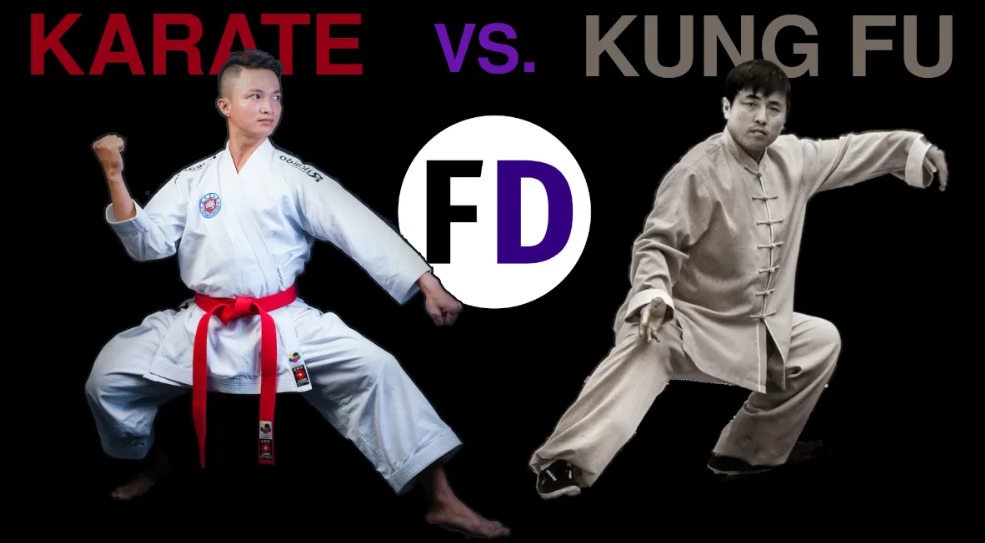
Comparing kung fu vs karate requires recognizing these represent genuinely distinct martial arts traditions from different countries entirely, with karate originating in Japan while kung fu encompasses numerous Chinese martial arts styles developed across that country’s extensive regional history.
Karate generally emphasizes more linear, direct techniques with an emphasis on powerful, committed strikes, while kung fu styles often incorporate more circular, flowing movements, reflecting different underlying combat philosophies rooted in each tradition’s distinct historical and cultural development.
This distinction isn’t absolute either, since kung fu itself encompasses enormous stylistic diversity, ranging from external styles emphasizing power and speed similar to karate through internal styles like tai chi that prioritize subtle energy manipulation and redirection instead.
Historical Origins and Cultural Development
Kung fu’s origins trace back considerably further historically than karate, with various Chinese martial arts traditions developing across thousands of years and numerous distinct regional schools, each producing genuinely different technical approaches and training philosophies.
Karate’s development, by contrast, occurred within a somewhat more concentrated historical timeframe, evolving primarily through Okinawan martial traditions before formal codification into distinct modern styles during the nineteenth and twentieth centuries specifically.
T
his differing historical depth explains some of the stylistic diversity within each tradition too, since kung fu’s considerably longer developmental history has produced hundreds of distinct regional styles, while karate’s more recent formal codification produced a somewhat more limited number of major recognized styles.
Comparing Training Methodology and Competitive Formats
Karate training typically incorporates structured belt progression systems with standardized testing requirements, providing clear developmental milestones that help practitioners track technical progress throughout their training across a formalized curriculum.
Kung fu training methodology varies more considerably between different styles and schools, since the discipline’s greater stylistic diversity means training approaches, testing requirements, and even the presence of formal ranking systems differ substantially between various kung fu traditions.
Competition formats similarly differ between these disciplines, with karate maintaining more standardized international competitive structures through organizations like the World Karate Federation, while kung fu competition often varies considerably depending on specific style and organizing federation.
Physical Demands and Training Focus
Both disciplines demand considerable physical conditioning, though the specific emphasis differs somewhat, with karate’s linear, powerful techniques often prioritizing explosive strength and precise technical execution over the more flexibility-intensive demands some kung fu styles require.
Kung fu’s greater stylistic diversity means physical demands vary considerably depending on specific style too, since internal styles like tai chi emphasize different physical qualities entirely compared to more external, combat-focused kung fu traditions requiring greater raw athleticism.
Understanding these physical demand differences helps prospective students choose appropriately between these disciplines, since personal physical preferences and goals should genuinely factor into selecting which particular martial art might prove most personally rewarding and sustainable long-term.
Choosing Between Different Martial Arts Traditions
Prospective students considering either karate or kung fu should genuinely evaluate their personal goals, whether prioritizing structured progression systems, specific self-defense applications, or particular cultural and philosophical traditions that resonate with their individual interests.
Local availability often significantly influences this decision too, since access to qualified, reputable instruction varies considerably by region, making practical considerations like nearby dojo or school quality genuinely important alongside pure stylistic preference when selecting a martial art.
Many practitioners ultimately find considerable value in cross-training across different martial arts traditions too, recognizing that karate’s structured technical precision and kung fu’s stylistic diversity can offer genuinely complementary skill development for dedicated students.
The Continuing Global Growth of Japanese Martial Arts
Karate’s continued international popularity reflects both its accessible belt progression system and its recent Olympic inclusion, having made its Olympic debut during the 2020 Tokyo Games, providing significant additional global visibility for the discipline.
This Olympic recognition has further cemented karate’s status as one of the world’s most widely practiced martial arts, complementing its already substantial global practitioner base built through decades of dedicated dojo instruction across virtually every populated continent.
Whatever specific martial art initially draws someone’s interest, whether karate’s structured technical precision or kung fu’s rich stylistic diversity, both traditions offer genuine physical development, self-defense application, and access to centuries-old combat philosophies worth exploring.
