


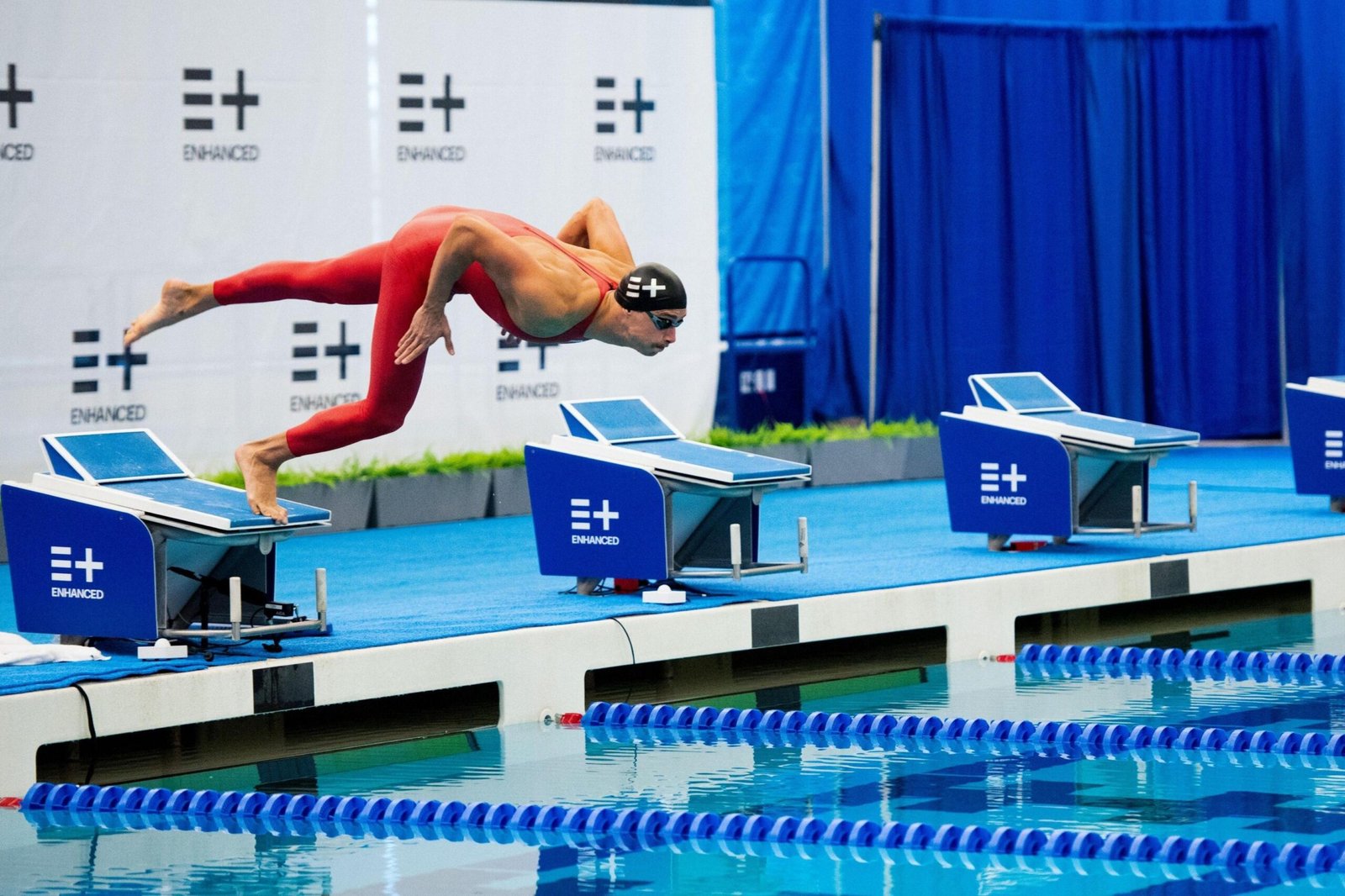
Sport has always existed in complicated relationship with human enhancement. The line between training, nutrition, recovery technology, and pharmacological assistance has never been as clean as anti-doping frameworks suggest, and a growing number of voices within competitive athletics are arguing that pretending otherwise has produced a system built on selective enforcement rather than genuine fairness. The Enhanced Games — a competition explicitly permitting performance-enhancing substances — has forced that conversation into the mainstream with an uncomfortable directness that traditional sporting institutions have struggled to dismiss. Fans following competitive athletics and combat sports can find dedicated markets at Dbbet.
What Are the Enhanced Games
The Enhanced Games is a competitive athletics event founded on the explicit premise that adult athletes should have the right to use performance-enhancing substances under medical supervision without disqualification. Backed by venture capital investment and positioned as a provocative challenge to the Olympic movement’s anti-doping framework, the competition invites athletes to compete in swimming, track and field, weightlifting, and combat sports without the testing protocols that govern participation in mainstream international competition. The founding argument is libertarian in character: consenting adults making informed decisions about their own bodies, supervised by medical professionals, should not be excluded from competition. Whether that argument is philosophically coherent or a commercially motivated rationalization of cheating depends entirely on which framework for understanding sport’s purpose the observer brings to the conversation.
The Steroid Olympics: How the Term Became Shorthand
The steroid olympics label attached quickly to the Enhanced Games because it captures both the event’s relationship to Olympic competition and its defining characteristic with economical precision. The framing is not neutral — it was partly adopted by critics to delegitimize the competition by associating it with the most stigmatized category of performance enhancement. Organizers have pushed back against the reductive label, arguing that their medical supervision model is actually safer than the unregulated black-market usage that exists throughout Olympic sports under the pretense of a clean competition. The terminology debate reflects the deeper dispute about whose narrative controls how the competition is understood — as reckless celebration of cheating or as honest acknowledgment of pharmaceutical reality in elite sport.
Performance Enhancing Drugs: What Athletes Actually Use
Performance enhancing drugs in competitive sport cover a spectrum far wider than the anabolic steroids that dominate public conversation. Erythropoietin — EPO — artificially increases red blood cell production and transformed professional cycling in the 1990s in ways whose consequences are still being litigated. Human growth hormone accelerates recovery and tissue repair in ways that are difficult to distinguish from natural variation in testing. Blood transfusions — autologous and otherwise — improve oxygen delivery through entirely biological mechanisms. Stimulants, beta-blockers, diuretics used to mask other substances, and therapeutic use exemptions for substances that provide measurable competitive benefit all exist within the current anti-doping framework in ambiguous relationships with what the system is theoretically designed to prevent. The Enhanced Games’ most uncomfortable contribution to the conversation is its insistence on naming what practitioners in Olympic sports discuss privately but rarely publicly.
Anti-Doping: The System Under Examination
Anti-doping frameworks built around WADA — the World Anti-Doping Agency — operate on a prohibited list that is updated annually, a testing regime that combines in-competition and out-of-competition sampling, and an adjudication process that has produced high-profile controversies alongside its legitimate convictions. The system’s credibility has been damaged by cases where positive tests resulted in minimal consequences for protected athletes, where entire national programs engaged in state-sponsored doping with delayed institutional response, and where the therapeutic use exemption system has been used in ways that strain the distinction between medical necessity and competitive advantage. Anti-doping proponents argue the system deters far more violations than it catches and that removing it would accelerate a pharmaceutical arms race that damages athlete health. Critics argue the system deters clean athletes more effectively than it deters sophisticated dopers.
The Athletes Who Have Engaged With the Enhanced Games
The Enhanced Games’ ability to attract credible competitive talent determines whether it remains a provocative concept or becomes a genuine competitive alternative. Several former Olympic-level swimmers and track athletes have publicly expressed interest or confirmed participation, drawn by prize money structures that dwarf Olympic compensation for most athletes outside the sport’s commercial mainstream. The competition’s organizers have been deliberate about recruiting athletes with genuine competitive credentials rather than merely fringe performers, understanding that legitimacy requires quality of competition rather than merely philosophical positioning. The athletes who engage most publicly tend to be those whose competitive windows are closing within mainstream sport or who have already navigated the anti-doping system’s consequences — their motivations are complex mixtures of financial opportunity, genuine philosophical alignment, and competitive drive that has no other sanctioned outlet.
Medical Supervision: The Enhanced Games’ Central Claim
The most substantive argument the Enhanced Games makes against its critics is that its medical supervision model reduces harm rather than increasing it. The counterargument to drug-free sport is not that performance-enhancing substances are harmless — it is that athletes use them regardless of prohibition, and prohibition drives usage underground where medical guidance is absent, dosing is unmonitored, and product quality is unverified. The Enhanced Games’ position is that bringing pharmacological enhancement into a medically supervised framework produces better health outcomes for athletes than a prohibition system that demonstrably fails to prevent usage. Whether that argument is accepted depends on whether one believes the Enhanced Games will create new users among athletes who would otherwise have remained clean, or whether it merely provides safer conditions for existing usage patterns that prohibition has failed to prevent.
The Olympic Movement’s Response
The International Olympic Committee and WADA have responded to the Enhanced Games with a combination of dismissal and defensive reassertion of anti-doping principles that reflects institutional discomfort with a challenge that cannot be ignored while also cannot be engaged with directly without legitimizing it. National Olympic committees have warned athletes that participation in the Enhanced Games may jeopardize their eligibility for Olympic competition — a deterrent that carries real weight for athletes still within their competitive window in mainstream sport. The threat reflects the Olympics’ continued ability to define sporting legitimacy for most athletes and most audiences. However, the Enhanced Games’ organizers argue that the response itself demonstrates their point — that the Olympic system uses eligibility threats to suppress a legitimate philosophical conversation about athlete rights rather than engaging with the underlying arguments honestly.
Implications for Mainstream Sport
The Enhanced Games’ existence forces conversations that governing bodies have successfully avoided for decades. If a parallel competition demonstrably produces faster swimming times, higher jumps, and stronger performances than Olympic competition, the public understanding of what Olympic results actually represent shifts. If the medical supervision model produces fewer documented health incidents than the black-market usage it parallels, the harm reduction argument becomes harder to dismiss. The competition’s long-term impact on mainstream sport’s anti-doping frameworks may be less about conversion — few expect WADA to adopt Enhanced Games principles — and more about pressure: forcing cleaner governance, more transparent TUE processes, and more honest public communication about what testing regimes can and cannot detect in the current pharmaceutical landscape.
What the Debate Reveals About Sport’s Values
The Enhanced Games controversy ultimately surfaces a question that sport has always contained but rarely examined directly: what is competition actually measuring? If the answer is human potential within natural biological limits, then anti-doping frameworks represent a necessary boundary around what sport claims to be. If the answer is human achievement through any means that a given era makes available — as athletic performance has always incorporated advances in nutrition, training methodology, equipment, and sports science — then the line between permitted and prohibited enhancement is a political and commercial choice rather than a principled one. Neither position is obviously correct, and the Enhanced Games’ most lasting contribution may be forcing that question into mainstream sports discourse with enough momentum that it can no longer be resolved simply by reaffirming existing institutional positions.
